
Waypoint Park & Trackside · Bellingham, WA
Waypoint Park and Trackside already host some of the best gatherings in the Pacific Northwest, on borrowed infrastructure. Bellingham Commons is a vision for making that permanent: one unified public commons where a general-admission stage built for real shows, a renovated historic landmark, and open, flexible festival grounds (the same open ground Fire & Story's fire circles need and a circus needs to pitch a big top) come together with the bike trails people already love here, built for daily use, not just the occasional event.
Why now
With Harcourt Development's rights to the site terminated, 18.8 acres of prime waterfront are an open question again for the first time in a decade. The Port and City are actively shaping what comes next, and the case worth making is simple: keep it whole, rather than splitting it into a stage here and a building there. One coherent commons: a general-admission stage built for real shows, a year-round indoor commons with a climbing gym, maker spaces, and meeting rooms inside the historic building, open flexible festival grounds, and the pump track and bike trails that already draw riders from across the region, all part of the same place.
"The businesses will make more money if there's a reason for everyone in Whatcom County to come down there." Andrew Shelton, local real estate agent and waterfront advocate, speaking at a Port & City waterfront workshop, February 2026 (Cascadia Daily News)
The main stage
Waypoint Park's natural bowl and waterfront backdrop already make it one of the best outdoor stage settings in Washington. Built out, it becomes a general-admission venue for 3,000–5,000 people: national headliners, multi-day festivals, and the kind of shows that currently skip Bellingham because there's nowhere here that can hold them. No fixed seating, on purpose: the same flat ground that hosts a touring act next week can host Fire & Story's scattered small stages and fire circles the week after, or clear out entirely for a circus big top. Fire & Story and Northwest Tune-Up already prove people will turn out by the thousands. The stage just gives that demand a permanent, professional home, without giving up the open ground that makes this site work for everything else.
A permanent stage, professional sound and lighting, modular decking, restrooms, concessions, and the flat general-admission lawn itself run roughly $8–20M. That's real infrastructure, built once, and right-sized, because it doesn't need fixed seating or a stadium roof to be a serious venue.
View full size ⤢
Same stage, same flat ground, same downtown skyline behind it, completely reconfigured for Fire & Story instead of a touring act. Sculptural fire braziers and lanterns replace the amps and monitors, and the crowd spreads out across the open lawn instead of facing one direction. Nothing about the venue had to change to make that happen. That's the reason to build it flat and open instead of fixed: the ground can adapt to whatever's happening on it, instead of every event having to work around a fixed layout.
View full size / download ⤢
Concerts and festivals, a stage that reconfigures instead of sitting fixed, a container village for everyday coffee and small retail, the pump and jump track, and grounds built for every season, not just event nights, all on the same open ground.
The historic anchor
On the same parcel as the amphitheater sits a vacant, historic industrial building, the second anchor of Bellingham Commons. Instead of tearing it down, our vision keeps it unmistakably industrial while turning it into a year-round indoor home for recreation, culture, and everyday connection, the place to be when it's raining, dark, or just too cold for the lawn.
View full size / download ⤢
Restored brick, warm architectural lighting, and steel-and-glass additions that respect what's already there, drawing on adaptive-reuse projects in Portland, Seattle, Denver, and Vancouver, BC. The building's tank room becomes a flexible indoor event hall and the site's built-in rain plan for outdoor programming, an indoor climbing gym anchors another wing, and a climbing wall on one exterior face turns a blank facade into the building's signature feature.
This building isn't meant to matter only on show nights. It's café tables filled on a Tuesday morning, a climbing wall busy after work, a plaza that's genuinely pleasant to sit in whether or not anything's scheduled. Every part of the site earns its keep every day of the week.
Why it matters
A working amphitheater and a renovated anchor building do more than make a nicer park. They give people across Whatcom County, and visitors from across the state and beyond, a reason to come downtown, spend an evening, spend money, and come back.
Fire & Story, Northwest Tune-Up, and the Noisy Waters Mural Festival already draw tens of thousands of people to this exact site every year, entirely on improvised, borrowed infrastructure. Northwest Tune-Up alone generated more than $2M in documented direct and indirect economic impact in a single 2024 weekend, including over 1,100 hotel room-nights for a city that doesn't have a major venue yet. Fire & Story, only in its third year, is already on a comparable track. Trackside Beer Garden, right on the grounds, has been called the best beer garden in the Pacific Northwest. The demand here isn't hypothetical, it's already showing up by the thousands every year. The bet is just making it permanent.
Compare it to Remlinger Farms in Carnation, WA, a 350-acre working farm that books national acts on a general-admission lawn and sells out every summer. Bellingham's site has salt water, mountain views, and 90,000 people within walking distance that Remlinger doesn't. Or look at Bend, Oregon, a similarly sized city whose general-admission amphitheater generates roughly $27M a year in regional economic activity, and as much as $2.3M from a single sold-out show.
A four-thousand-person concert, a real festival ground, a coherent public space: none of it works if the site gets carved into small parcels between private buildings. The space needs to stay whole to do what it's actually capable of.
Preserving it as a unified public commons, built simply and fiscally responsibly, gives Bellingham something most cities spend decades trying to build: a defining public place with a distinct identity and real economic pull for the entire county.
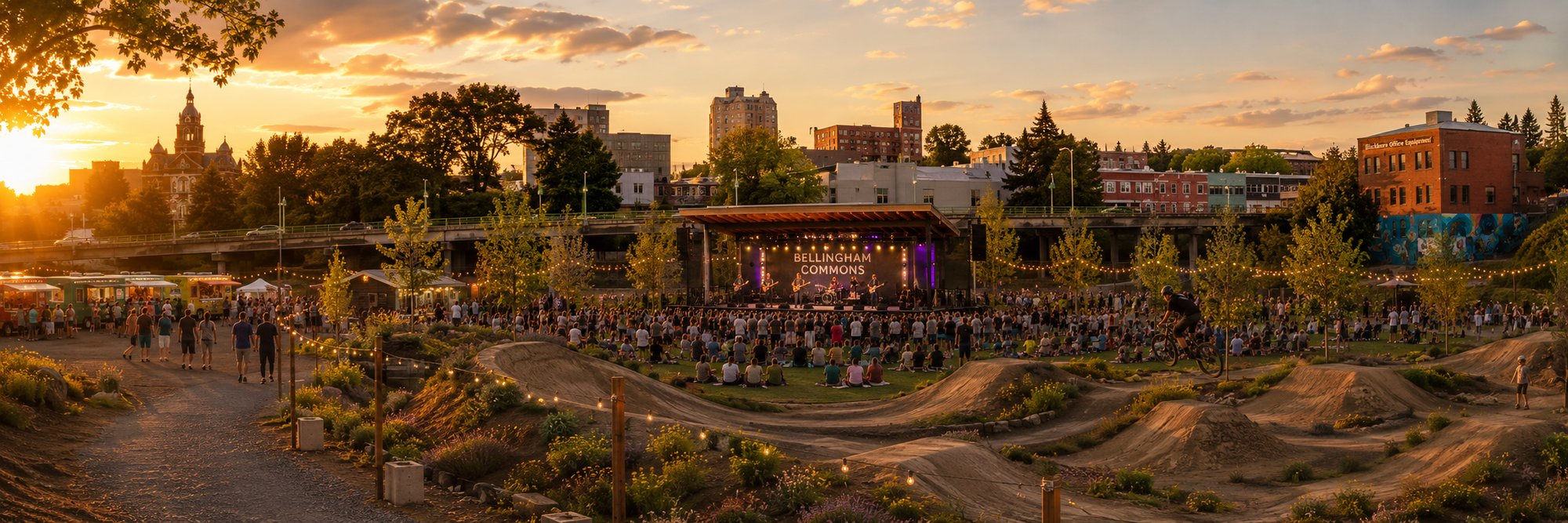
Every part of this only works because people already show up: riders coming for the pump track, families at the mural festival, a couple thousand people on a lawn for a concert, someone just grabbing a beer at Trackside on a Tuesday. Bellingham Commons doesn't invent that appetite, it just gives it somewhere permanent to happen.
Restaurants, breweries, hotels, and shops downtown all do better when there's a standing reason to come to the waterfront, not just a one-off festival weekend. Some of that is new money from outside Whatcom County: hotel nights, weekend trips, visitors who wouldn't otherwise be here. Some of it is Whatcom County residents choosing to spend an evening, and a dinner, right here instead of somewhere else. Both are real. A year-round anchor building and a real show season turn occasional visitors into regulars, and regulars into the kind of foot traffic that makes a whole district worth investing in.
How this actually happens
This doesn't require a new law or a new agency. It requires the Port and City to use tools Washington State already gives them: transfer this parcel from Port ownership to City ownership, then pay for construction with a realistic mix of grants, dedicated funding districts, and voter-approved measures built for exactly this kind of project.
Washington ports can sell property once their commissioners formally declare it surplus to the Port's own needs, which requires a public hearing. From there, state law lets the Port and City complete the sale through a standard interlocal agreement, the same routine tool governments use to share land, services, and projects. One detail worth knowing: state law requires the Port to be paid fair value for the land, not to give it away, so the purchase price is part of what the City needs to fund alongside construction.
Once the City owns the parcel, it can develop the amphitheater and the Commons building directly through its Parks & Recreation Department, the same way it manages every other park in Bellingham. Or it can place the project under a Metropolitan Park District, a special local government that Washington created specifically to acquire, build, and run parks with its own dedicated funding stream instead of competing every year against police, roads, and everything else in the City's general budget.
Grants help, but they're not a funding plan on their own. The state's Aquatic Lands Enhancement Account and Washington Wildlife and Recreation Program are real and worth pursuing, but they run around $1M per grant cycle each for qualifying acquisition and development work. Against a $22-44M build (land, the stage, and the Alcohol Plant together), that covers a down payment, not the project. The core of this has to come from Bellingham itself committing a dedicated funding source, most likely paired with bonds, so this gets built now instead of waiting decades to save up cash. The venue itself adds a real, if smaller, piece too: facility fees, food and beverage, and parking from a real show season could realistically cover a quarter to half of the annual debt service on a bond, on top of everything above, not instead of it.
Very possibly, and Bellingham has a real track record of doing exactly this. Voters have approved the Greenways levy four times since 1990, most recently in 2023 with 67% approval, a dedicated property tax now raising $8.7M a year for parks and trails. Whatcom voters have also approved sales tax increases twice for transit, in 2002 and 2010. The pattern here is clear: people in this county will tax themselves for infrastructure they can see and use. A Public Facilities District's sales tax tools, a Metropolitan Park District levy, or a straightforward voter-approved measure are all realistic paths. The real question is which mix pairs best with bonds and grants, not whether voters here would say yes.
Every piece of this ask already has a legal path in Washington State. What's missing isn't a new law, it's the will to use the ones that already exist.
Sources: MRSC on Metropolitan Park Districts · MRSC on Public Facilities Districts · RCO: Aquatic Lands Enhancement Account · RCO: Washington Wildlife and Recreation Program · RCW 53.08.090 · Cascadia Daily News on Greenways 5 · Ballotpedia on WTA tax votes · City of Long Beach Amphitheater FAQ
Get involved
Join the list to follow the plan as it develops: public meetings, ways to weigh in with the City and Port, and updates as the vision moves forward. No spam, no noise, just what matters when it matters.